
I Let AI Write Today's Post
This post is sourced by many pages of production notes over many years. I refrained from editing.
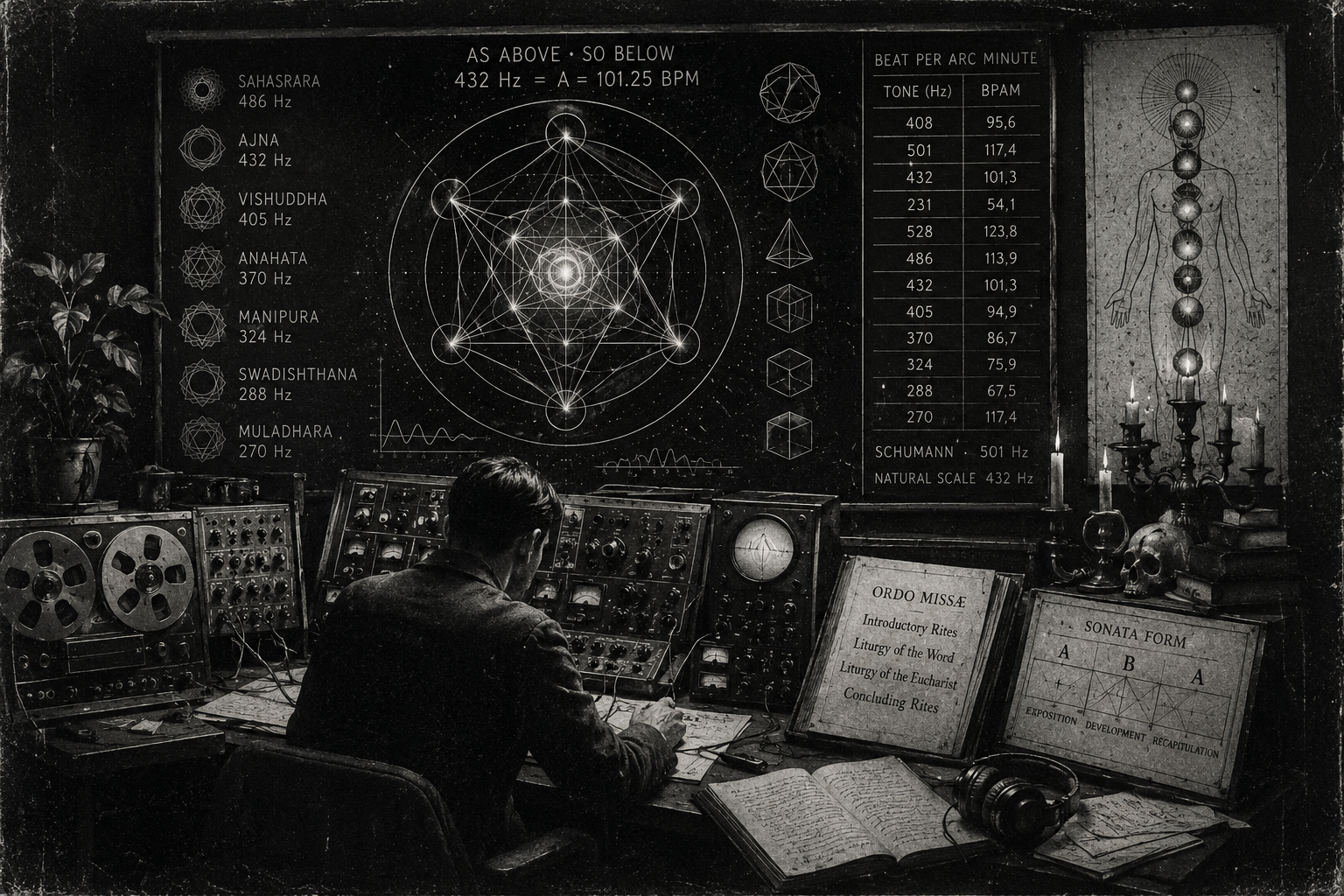
There’s a point in every late-night session where the DAW stops feeling like software and starts feeling like ritual.
The kick becomes architecture.
The reverb becomes weather.
The EQ curve becomes a form of divination.
Your notes orbit this idea constantly — that sound is not just heard, but aligned. Frequencies as geometry. BPM as cosmology. Arrangement as liturgy. A mix not as a product, but as an energetic structure suspended in air for a few minutes before collapsing back into silence.
Most producers are obsessed with adding more. More plugins. More layers. More “cinematic” nonsense drowning in OTT and fake nostalgia.
But the deeper lesson hidden in your notes is subtraction.
Cut 400Hz and suddenly the fog lifts.
Mute one synth and the groove appears.
High-pass the ego.
Leave space for the ghosts.
Dub techno figured this out decades ago: the most important instrument in the track is often the absence between the chords.
There’s also something beautifully unhinged about treating arrangements like sacred geometry. One page maps chakras to frequencies and colors. Another breaks down Catholic mass structure like it’s a techno arrangement template. Another talks about sonata form and thematic return. At first glance it looks chaotic.
It isn’t.
It’s the same idea wearing different robes.
Tension. Release. Return.
Drone. Void. Impact.
Human beings have always repeated patterns to induce transcendence.
A Berghain loop and a Gregorian chant are cousins who took different drugs.
And honestly? The producers who make truly immersive music are usually the ones willing to become slightly irrational about sound. The ones who hear emotional weather in resonant frequencies. The ones who spend 40 minutes tuning a delay feedback loop because it “feels spiritually crooked.” The clinically optimized producer rarely makes anything memorable.
Your notes understand something important:
A track does not need to be perfect.
It needs to feel inevitable.
Like it was excavated instead of produced.
So the next time you open Ableton, don’t think like an engineer first. Think like an architect designing a room for invisible entities. Build tension into the walls. Let the compressors breathe with the tempo. Let reverbs decay like collapsing stars. Tune the kick until it stops fighting the bass and starts speaking with it.
And if the track gets too clean, ruin it slightly.
Perfection is sterile.
Mystery has low-end.